

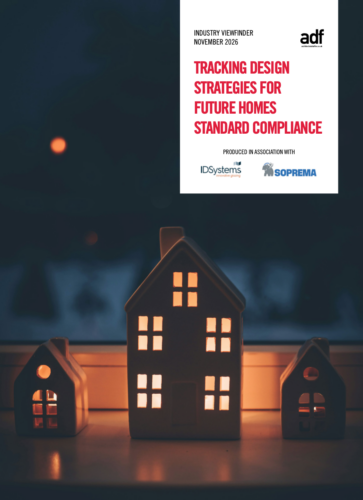
The Future Homes Standard (FHS), due to come into force on 24 March 2027 with a 12-month transition period, represents a significant shift in how new homes are designed, specified and constructed. Alongside the introduction of the Home Energy Model and revisions to Parts L and F of the Building Regulations, the Standard aims to deliver homes producing at least 75% fewer carbon emissions than those built to 2013 standards.
However, achieving compliance presents considerable challenges for architects and specifiers. Increasing insulation requirements, the transition to low-carbon heating systems, improved ventilation and greater integration of renewable technologies demand a more coordinated approach to building design. Balancing energy efficiency with overheating prevention, indoor air quality and practical construction considerations adds further complexity, particularly for higher-density developments.
Ensuring that new homes perform as designed is another critical consideration. Improved airtightness, insulation continuity, thermal bridging, ventilation commissioning and appropriate heat pump sizing will require greater attention to specification accuracy, construction quality and technical coordination. Architects must also consider electricity grid constraints, supply chain readiness and the implications of adapting existing house designs to meet evolving regulatory requirements.
This whitepaper examines how the architectural sector is preparing for the Future Homes Standard, drawing on research into building fabric, heating strategies, ventilation, glazing, renewable technologies and integrated design approaches. It explores the technical and practical challenges facing architects and specifiers, including regulatory uncertainty, overheating risks, design coordination and achieving compliance without compromising building performance.
The findings provide valuable insight into industry readiness, emerging specification priorities and the design strategies architects are adopting to deliver compliant, energy-efficient homes at scale, while maintaining construction quality, addressing performance gaps and creating healthier, more sustainable living environments.
Request the full report
Tagged
OrganisationsID Systems Soprema