
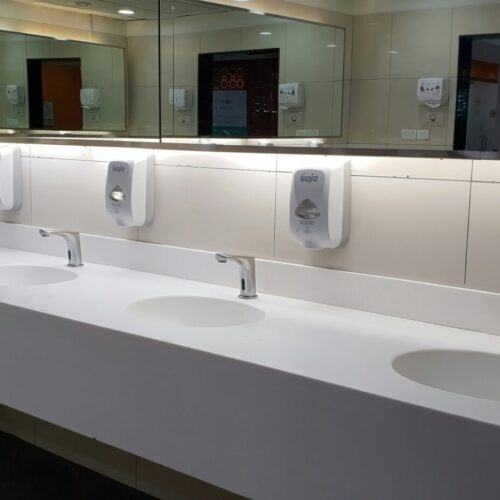
The need for commercial clients and their designers to provide washrooms which balance the needs of all users is paramount, but an increasingly challenging task, driven by tighter regulation. Despite the advent of more and more gender neutral toilet facilities in recent years, increases in safety, privacy and dignity concerns, such as around use of communal washbasins, reduced choice and increased queuing for some users.
As a result, the previous Government updated Part T of the Building Regulations in October 2024, citing “particular concerns from women, elderly and the disabled who felt unfairly disadvantaged as publicly accessible toilets are increasingly being converted into gender neutral facilities.” The new Regs prohibited washrooms in workplaces which require two sexes to use the same washing facilities.
Following that, a 2025 Supreme Court ruling, confirmed that ‘sex’ meant ‘biological sex,’ meant that single sex toilet facilities could only be used by people of the same ‘birth sex.’ While offering clarification of the legal position, this also raised confusion for building owners, including around provision for trans people using the building. While legal protection against discrimination remains, where single sex washrooms are provided, trans women are not permitted to use them, for example, so alternative provision would be needed for compliance.
Clients are obliged to ensure all users have access to washroom provision which offer dignity, safety, and no discriminatory difference in quality. This will pose complex challenges for clients and washroom designers. This round table will explore the issues, attempt to offer some clarity for designers and clients, and realistic solutions which have been developed in order to help resolve such issues in commercial workplace environments.